

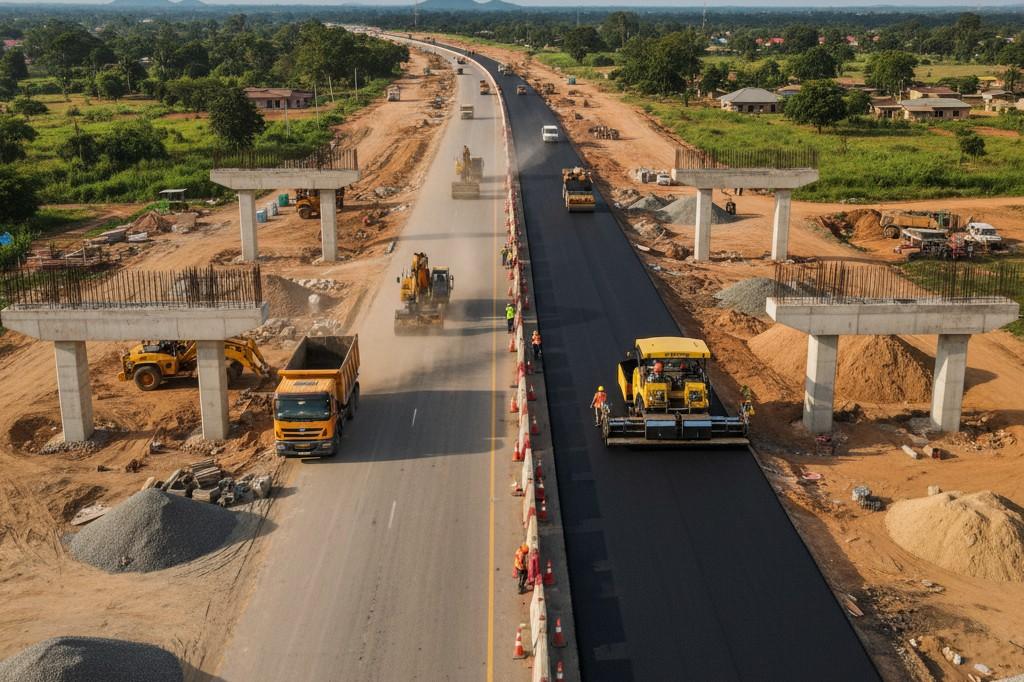
1. Continental and Trans-Regional Road Corridors
Some of Africa’s most ambitious infrastructure developments are continental and cross-border transport corridors. Their objective is to establish an integrated road network that connects countries, facilitates international trade and reduces transportation costs.
Trans-African Highway Network
The Trans-African Highway Network is one of the continent’s most ambitious transport initiatives. Covering more than 56,000 kilometers across multiple routes, the network is designed to connect major economic centers and regions in North, West, East and Southern Africa.
The initiative aims to improve cross-border transport, facilitate regional integration and establish more efficient trade connections between African countries.
Trans-Sahara Highway (African Unity Road)
The Trans-Sahara Highway is a strategic north-south transport corridor extending approximately 4,500–5,000 kilometres. It is intended to connect Algeria and Tunisia in North Africa with countries further south, including Mali, Niger, Nigeria and Chad.
Once fully developed and operational, the highway is expected to strengthen trade links between North and West Africa, improve access to markets and support economic development across the Sahara region.
Cairo–Cape Town Highway
The Cairo–Cape Town Highway is an ambitious north-south transport corridor intended to connect Egypt’s Mediterranean coast with South Africa.
The project forms part of the broader vision of establishing an integrated African road network, linking countries and major commercial centres across eastern and southern Africa. It is expected to improve regional mobility and facilitate trade along one of the continent’s longest transport routes.
LAPSSET Corridor – Kenya, Ethiopia and South Sudan
The Lamu Port-South Sudan-Ethiopia Transport (LAPSSET) Corridor is a major regional infrastructure programme involving Kenya, Ethiopia and South Sudan.
With an estimated investment exceeding $20 billion across its planned infrastructure components, the project includes highways, a deep-sea port, railways, oil pipelines and airports.
The corridor is designed to provide landlocked Ethiopia and South Sudan with alternative access to international markets through Kenya’s coastline. It also has the potential to stimulate investment, promote industrial development and open up previously underserved regions.
Lobito Corridor – Angola, Democratic Republic of Congo and Zambia
The Lobito Corridor is an important regional trade and infrastructure initiative connecting mineral-rich areas of Central and Southern Africa to the Atlantic Ocean through Angola’s Port of Lobito.
The initiative involves railway rehabilitation, road improvements and logistics infrastructure aimed at facilitating the transportation of minerals and other commodities to international markets.
Among the associated road developments is the approximately 105-kilometre Minoanga–Jimbe road section, which forms part of wider efforts to improve regional connectivity.
2. Major National and Regional Highway Projects
In addition to continental transport corridors, several African countries are developing major national highways and expressways to improve domestic connectivity, reduce travel times and support economic growth.
Tiznit–Dakhla Expressway – Morocco
Morocco’s Tiznit–Dakhla Expressway is a major highway development stretching approximately 1,050 kilometres along the country’s Atlantic corridor.
The project is intended to improve connectivity between southern Morocco and the country’s northern economic centres, while supporting trade, tourism, logistics and economic development in the southern regions.
It is also strategically important for strengthening transport links along Morocco’s Atlantic coastline.
Isiolo–Wajir–Mandera Highway Corridor – Kenya
Kenya’s Isiolo–Wajir–Mandera road corridor is a major infrastructure initiative intended to improve transport connectivity across the country’s northern region.
Spanning more than 750 kilometres through areas including Modogashe, Wajir, El Wak and Rhamu, the corridor is designed to connect remote communities with the rest of the country.
The project is expected to improve access to essential services, facilitate livestock and agricultural trade, strengthen regional security and open up northern Kenya to greater economic investment.
Nairobi–Mombasa Expressway – Kenya
The proposed Nairobi–Mombasa Expressway is one of Kenya’s major planned highway developments.
Designed as a four-to-six-lane dual-carriageway toll road, the expressway is intended to provide an alternative to the heavily used Nairobi–Mombasa transport route.
The project aims to reduce congestion, improve freight transportation and facilitate faster movement between Nairobi and the Port of Mombasa, one of East Africa’s most important maritime gateways.
Its development could have significant implications for logistics, tourism, manufacturing and regional trade.
Mau Mau Roads Programme and Kenol–Marua Dual Carriageway – Kenya
Kenya is also implementing major road expansion and improvement initiatives under programmes such as the Mau Mau Roads Programme.
These developments aim to improve connectivity across central and other parts of the country, particularly in agricultural and rural communities.
The Kenol–Marua Dual Carriageway is another significant highway development intended to improve traffic flow and enhance connectivity along the Nairobi–Mount Kenya transport corridor.
Other strategic developments, including the Lake Victoria Ring Road, are intended to strengthen connectivity among counties in western Kenya and improve access to regional economic opportunities.
3. East African Community Cross-Border Road Corridors
The East African Community (EAC) continues to prioritize regional transport infrastructure as part of its wider economic integration agenda.
Cross-border highway projects and one-stop border posts are helping improve the movement of goods and people between Kenya, Tanzania, Uganda, Rwanda and Burundi.
Important regional routes include:
Arusha–Namanga–Athi River Corridor: A strategic transport route connecting Tanzania and Kenya, supporting cross-border trade and regional mobility.
Arusha–Holili–Taveta–Voi Corridor: A major transport link connecting northern Tanzania with Kenya’s coastal and inland transport networks.
These corridors are particularly important for reducing transport bottlenecks, improving border efficiency and supporting the movement of agricultural products, manufactured goods and other commodities across East Africa.
4. Why Africa’s Major Road Projects Matter
The development of modern highways and regional transport corridors is central to Africa’s long-term economic transformation.
The benefits extend beyond improved road infrastructure and include several important economic and social opportunities:
Regional trade and economic integration: Better road networks make it easier for African countries to trade with one another, strengthening regional markets and supporting the objectives of the African Continental Free Trade Area (AfCFTA).
Reduced transportation costs: Modern highways can reduce travel times, improve logistics efficiency and lower the cost of moving goods between production centres, markets and ports.
Industrial and agricultural development: Improved transport infrastructure allows farmers, manufacturers and businesses to reach larger markets while encouraging investment in industrial and logistics facilities.
Employment creation: Large infrastructure projects generate employment opportunities during construction and create additional jobs in transport, logistics, tourism and related industries.
Improved access to remote communities: Roads connecting underserved regions can improve access to healthcare, education, commercial services and other essential facilities.
Stronger regional connectivity: Cross-border corridors strengthen relationships between neighboring countries and support the development of integrated regional economies.